Support & retention
A partial may use clasps or other attachments. We assess your remaining teeth to decide what can support the denture.

NEDIC Dartmouth
Replace several missing teeth while keeping the natural teeth that remain.
Understand your options
A removable partial denture fills gaps in your smile. Its replacement teeth connect to a base, with a design that works around your remaining teeth and gums.
A partial may use clasps or other attachments. We assess your remaining teeth to decide what can support the denture.
The tooth arrangement and denture design are planned around your smile, bite, and available space.
You remove the partial for cleaning. Your team shows you how to insert and remove it without forcing the attachments.
The NEDIC approach
We review your remaining teeth, gums, and bite, then discuss suitable designs. Your doctor and laboratory team use your records to plan the partial and check its fit. Any recommended work on supporting teeth is explained in advance.
Your next step
The goal is to fill the spaces left by missing teeth and support appearance, speech, and chewing. Getting used to a new partial takes practice, and adjustments may be needed.
Clean the partial and your natural teeth as instructed. Attend regular checkups and contact us for sore spots or changes in fit.
Compare partial options
See how acrylic, flexible, and cast metal partials compare in the areas that matter to your everyday comfort.
On smaller screens, swipe across to compare all three options.
| What matters to you | 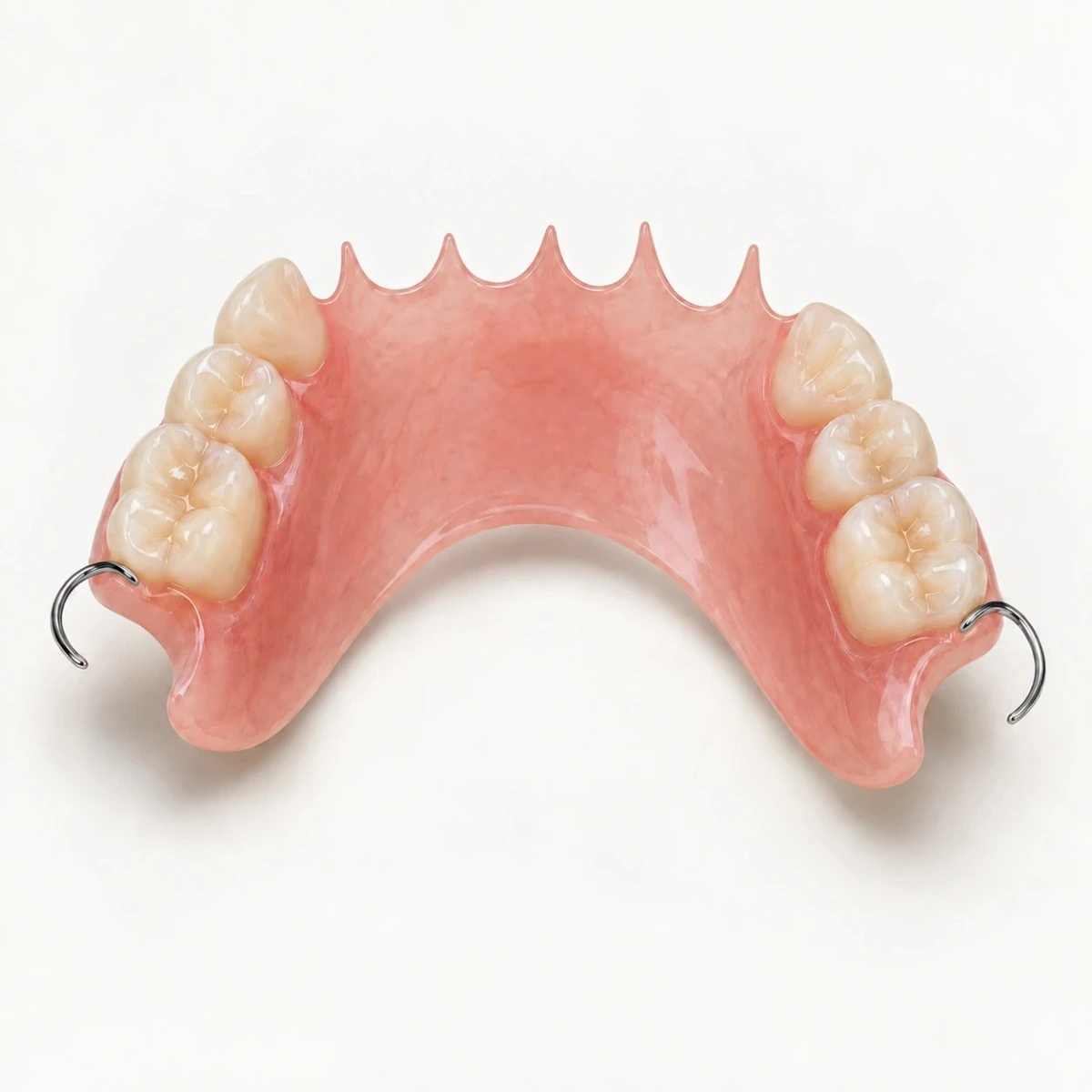 | 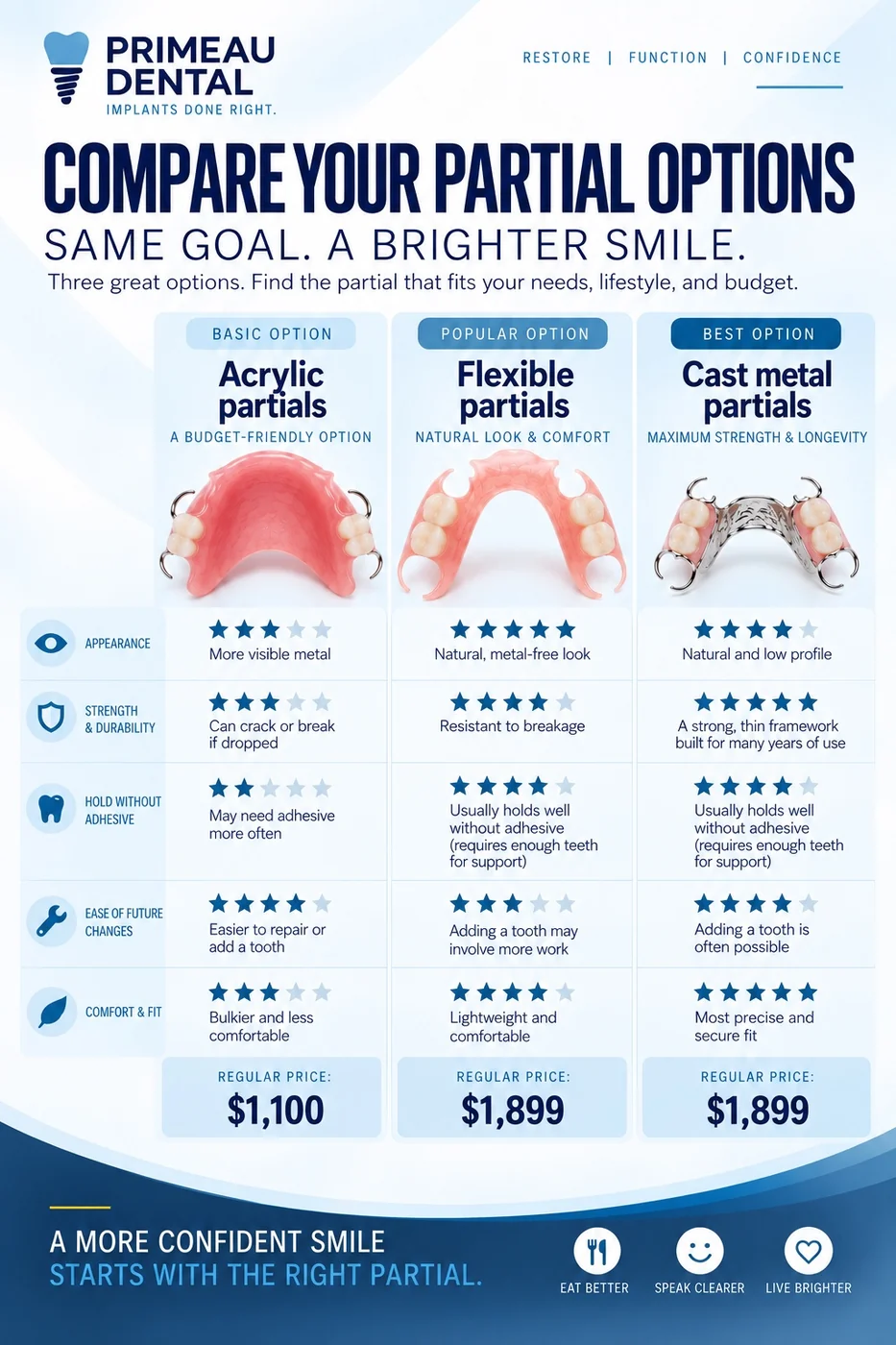 | |
|---|---|---|---|
| Appearance | Metal clasps may be visible. | Gum-colored clasps offer a metal-free appearance. | A low-profile design; some clasps may show. |
| Strength & durability | An acrylic base can crack or break if dropped. | Flexible material resists some types of breakage. | A strong, thin metal framework. |
| Hold without adhesive | Retention varies with the clasp design and supporting teeth. | Can hold well when the remaining teeth provide suitable support. | Planned clasps and rests provide support and retention. |
| Future changes | Often easier to repair or add a tooth. | Adding teeth or modifying the base can be more involved. | Adding a tooth may be possible, depending on the framework. |
| Comfort & fit | Generally a bulkier base. | A lightweight, flexible feel. | A slim framework, individually fitted. |
Choose with confidence
The best partial for you depends on more than appearance alone. We consider the health of your remaining teeth, the support available, your bite, and how the design will fit into your daily life.
Replacement teeth sit in a pink acrylic base, often with metal clasps. This can be a practical choice when a lower initial cost or the ability to make future changes is a priority.
Acrylic designs may feel bulkier, and clasps can be visible. Repairs or adding a tooth are often possible, depending on the design and changes in your mouth. We will explain whether this is suitable for your situation.
A flexible, gum-colored base can create a discreet appearance around the remaining teeth. This option may appeal to patients who value a lightweight feel and less visible metal.
A flexible material is not the right choice for every pattern of missing teeth. Support, bite, and material-specific maintenance matter. Relining, repairing, or adding a tooth may be more involved than with some acrylic designs.
A thin, rigid metal framework supports the replacement teeth. It offers a strong structure with less bulk and a design carefully planned around your remaining teeth.
Some clasps may remain visible when you smile. The supporting teeth must be evaluated, and any preparation they need will be discussed first. Future adjustments or adding teeth depend on the framework and your oral health.
The details that matter
We talk through how visible the attachments may be, how much space the partial needs, and how it will be supported when you chew. No material is the best choice for everyone; your mouth and your priorities guide the recommendation.
Your visits may include impressions or scans, bite records, and fitting appointments. Our doctor and laboratory team review the fit, appearance, and bite with you, then explain how to insert, remove, and care for your partial.
A new partial can take time to feel familiar. Contact us about rubbing, soreness, or looseness rather than bending clasps or adjusting it yourself. Your natural teeth and gums need regular care alongside the denture.
A little more clarity
That depends on the material, attachment design, and teeth being replaced. We consider your smile line and explain the likely appearance before you choose your partial.
Sometimes. Acrylic partials are often easier to modify, while flexible materials and cast frameworks have design-specific limits. Ask us about future changes during planning.
A partial is designed to use the available teeth and tissues for support and retention. Whether adhesive has any role depends on your individual design and fit. If the partial becomes loose, arrange an assessment rather than relying on adhesive to solve the problem.